Bob Dylan has written hundreds of songs that defy time, but few reach the disarming purity of Knocking on Heaven’s Door.
Released in 1973 as part of the soundtrack for Pat Garrett & Billy the Kid, this minimal ballad quickly moved beyond its cinematic context to become one of the most recognizable and widely reinterpreted songs in music history.
The meaning of Knocking on Heaven’s Door by Bob Dylan does not lie in grand statements or elaborate metaphors. It lies in the quiet acceptance of a man who lays down the weight of his violent life and prepares to knock on the final door, without anger or despair.
The origin of the expression and why Dylan chose it
The expression “knocking on heaven’s door” was not invented by Dylan. It is an old English idiom used for generations to describe someone who is close to death, as if they were gently knocking on the gates of heaven while waiting for an answer. Dylan adopted the phrase exactly as it was, without decorating it with complicated language, and that is the first stroke of genius. Why choose it? Because it evokes a simple gesture, almost childlike, repetitive and patient. A calm, respectful and inevitable knock. As biographer Clinton Heylin notes in several passages of his works on Dylan, it is “an exercise in splendid simplicity.” The title is powerful precisely because it says exactly what it is, leaving the listener free to place their own ending inside it. In an era of elaborate and baroque lyrics, Dylan chose the shortest path, and it worked.
The context of the film Pat Garrett & Billy the Kid
The song was born directly from the set of Pat Garrett & Billy the Kid, the 1973 western directed by Sam Peckinpah. Dylan did not only compose the soundtrack. He also played the character Alias, an enigmatic helper of Billy, living among the dust and heat of Mexico during the shooting.
The scene that inspired the song is the death of Sheriff Colin Baker, played by Slim Pickens. Mortally wounded, he lies near a river while his wife, played by Katy Jurado, watches from a distance in one of the most memorable moments of the film. There are no dramatic lines of dialogue, only glances and silence. Dylan captured that exact moment and turned it into music.
The badge and the guns are not romantic symbols of the Old West. They represent the burden of a life spent imposing order through violence. The film, with Peckinpah’s characteristic rawness, provided the perfect environment for a song that refuses the typical heroic mythology of Hollywood westerns.
The rapid creation: written on a plane and recorded in Burbank
The story behind the song’s creation is almost legendary. According to Rudy Wurlitzer, the screenwriter of the film, Dylan scribbled the two verses on a sheet of paper while flying to the film set. After landing, he showed the lyrics to Wurlitzer one line at a time, simply saying, “Here.”
The recording took place at Burbank Studios in February 1973 during the sessions for the soundtrack. Produced by Gordon Carroll, the track was recorded with a very minimal arrangement. Acoustic guitar, harmonica, soft drums and female backing vocals that add a light gospel tone.
The single was released on August 8, 1973 and reached number 12 on the Billboard Hot 100. Dylan turned a brief cinematic moment into a timeless classic in only a few hours of work.
Analysis of the first verse: the weight of the badge
The lyrics open with an intimate and final request:
“Mama, take this badge off of me
I can’t use it anymore
It’s gettin’ dark, too dark for me to see”
“Mama” is the affectionate name the sheriff uses for his wife in the film scene, not a distant mother figure. The badge symbolizes decades of service, gunfights and morally complex decisions. Taking it off means surrendering that identity and admitting that the role has consumed everything.
The darkness is not an abstract metaphor. It is the fading of sight, the body slowly giving up. Dylan allows the listener to feel death through failing senses. In these few lines he condenses the entire trajectory of a life shaped by law and violence, now asking only to be released.
The chorus: the knocking that hypnotizes and comforts
The beating heart of the song is the chorus:
“Knock, knock, knockin’ on heaven’s door”
Repeated four times per verse, it becomes a rhythmic mantra. It is not a powerful stadium chant but a persistent and almost mechanical pulse, similar to a heartbeat slowing down or someone literally knocking on a door.
Dylan sings it with a low and almost confidential voice in the early recordings. The repetition does not become tiring. Instead it becomes hypnotic, inviting the listener into the mindset of someone waiting patiently.
Some listeners hear peaceful resignation in it. Others hear a subtle anxiety about what lies beyond. Dylan leaves the interpretation open, and the chorus has carried the song for more than fifty years.
The second verse: burying the guns forever
The final emotional blow arrives with the second verse:
“Mama, put my guns in the ground
I can’t shoot them anymore
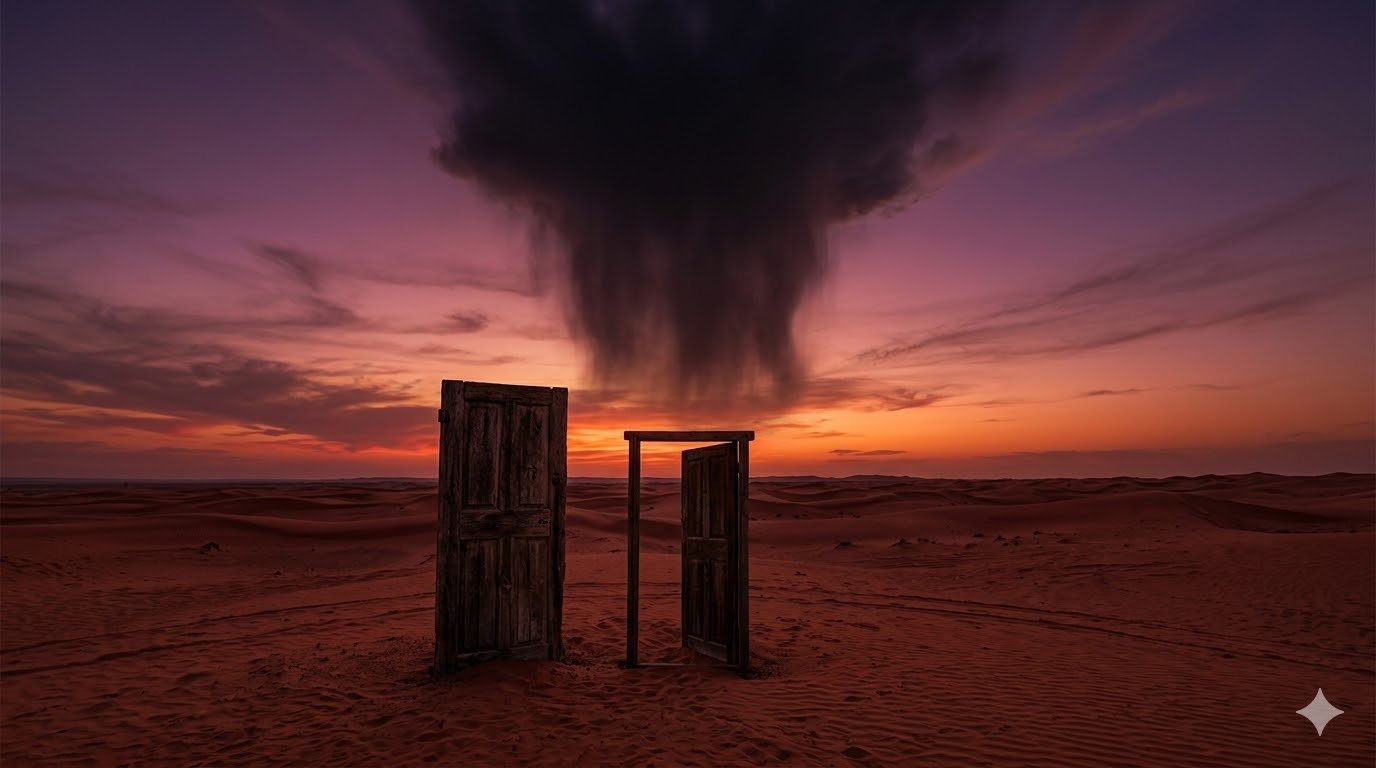
That long black cloud is comin’ down”
The guns are not passed on to someone else. They are buried. This is a radical act of disarmament. The “long black cloud” is perhaps the most vivid image in the song, a dark cloud descending like a veil and covering the sky.
The darkness is no longer only in the eyes. It now surrounds the entire world. Here the meaning expands. It is not just the death of a man but also the rejection of a life defined by violence. Dylan, in the middle of the 1970s, expresses a quiet form of pacifism without political slogans.
The essential production that made the song immortal
The recording is intentionally stripped down. No excessive overdubs and no technical showmanship. Just voice, guitar, harmonica breathing like a final sigh, and backing vocals that wrap around the melody without overwhelming it.
This simplicity amplifies the message. When the content is this direct, decoration becomes unnecessary. As Clinton Heylin notes, the “splendid simplicity” is the true strength of the song. It has sold millions of copies and topped charts around the world, yet it remains faithful to its original minimal form.
The lasting impact: covers, live performances and cultural presence
Dylan has performed Knocking on Heaven’s Door live hundreds of times. According to data from his official site and archives such as setlist.fm, he has played it around 359 times since its live debut in 1974.
It appeared frequently during the 1974 tour with The Band, later documented on the live album Before the Flood, and also in collaborations with the Grateful Dead.
Famous cover versions include Eric Clapton, who recorded a more energetic rock version, and Guns N’ Roses, who transformed it into a stadium anthem in 1990. The song has also inspired countless reggae, folk and acoustic interpretations around the world.
It has appeared in numerous films, series and soundtracks. Why does it endure? Because it speaks to anyone who has ever felt the weight of a “badge” that became too heavy to carry. A soldier, an exhausted parent, or anyone standing at the edge of a personal boundary.
Why it still touches people after fifty years
In a catalog full of riddles and lyrical revolutions, Knocking on Heaven’s Door remains one of the rare moments where Dylan chooses complete clarity.
No cryptic prophecies and no obscure references. Just two verses that look directly at the end of life and quietly say, “It’s okay.”
The reason it is called Knocking on Heaven’s Door is simple. That ancient expression, combined with the film scene, creates a universal image of peaceful surrender.
In a world that constantly rushes forward, that slow knocking still manages to stop time.
Let us know your thoughts in the comments below. If this song has meant something to you, personal stories are always fascinating and often reveal things we would never discover alone.
Thanks for reading, see you next time.