
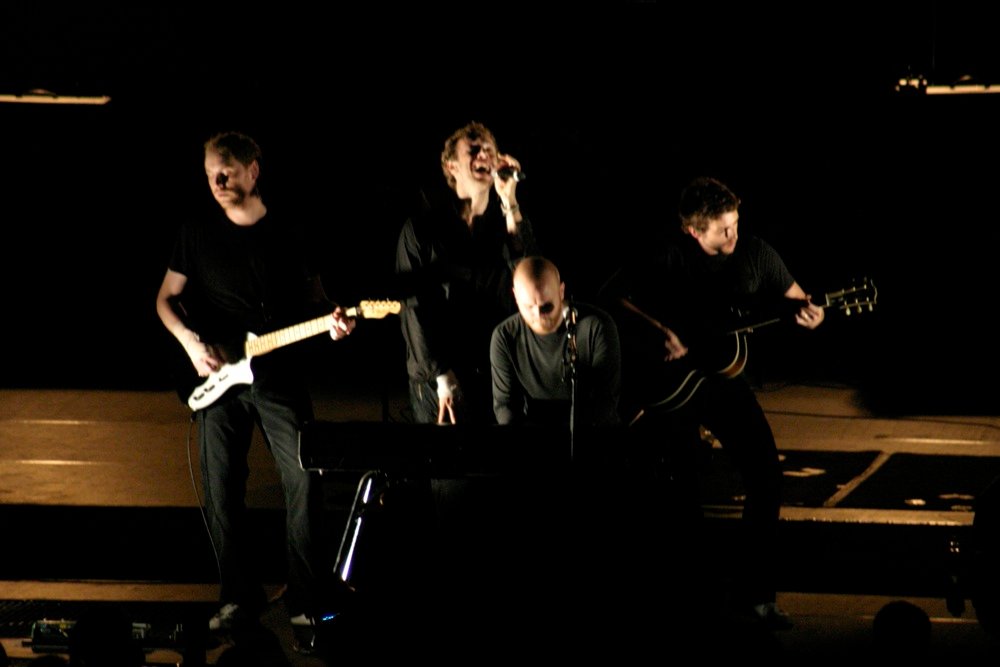
The story of Coldplay didn’t begin with a TV audition or a manager randomly discovering them in a garage. It began among cold cups of tea, out-of-tune guitars, and jam sessions on the staircases of a university dormitory. Four ordinary students deciding to play music together, who would eventually end up filling stadiums all over the world.
If you think this is the usual “zero to hero” story, get ready, because there were fierce arguments, EPs sold out of car trunks, slammed doors, and rules written after a fight that nearly broke the band apart. Yet it’s precisely these moments that make the story of Coldplay feel so real and relatable to anyone who has spent nights practicing chords, hoping someone would eventually listen.
The Key Figures in Coldplay’s Story: Four Personalities That Fit Perfectly Together
To truly understand the story of Coldplay, you need to know the four friends individually, because each of them brings a different piece to the puzzle.
Chris Martin is the singer, pianist, and main songwriter. He arrives at University College London in 1996 to study Classics. He is the emotional perfectionist of the group, anxious, sensitive, the kind of person who cannot sleep if a melody doesn’t feel completely right. His voice, with its natural falsetto, quickly becomes the band’s signature sound. But behind the charisma on stage is someone who writes from the heart and sometimes risks pushing everything to the breaking point because of the pressure he puts on himself.
Jonny Buckland is the lead guitarist, the quiet and intuitive talent. Born in Wales, he studies geography and meets Chris during orientation week. Jonny is reserved, almost shy socially, but when he picks up the guitar he becomes the melodic heart of the band. He is often the one who comes up with simple yet brilliant riffs that stay in your head for days. Without his instinctive touch, many songs simply wouldn’t exist.
Guy Berryman, the Scottish bassist, is the one who keeps the balance and clarity within the group. He studies mechanical engineering and brings a sense of stability the others sometimes envy. He isn’t someone who seeks the spotlight, but when he speaks, people listen. His bass lines are solid and understated but essential: they hold the sound together without ever stealing attention. In difficult moments, he is often the one suggesting the small solutions that end up changing everything.
Will Champion, the drummer, is the energetic, self-taught glue of the band. He comes from Southampton, studies anthropology, and originally wasn’t even supposed to play drums. He joins the group at the last minute in January 1998, replacing a roommate who backed out. Will learns everything on the spot. He’s a multi-instrumentalist who can also play guitar and piano when needed, and he has the strongest personality in the band: direct, passionate, and never afraid to speak his mind. His energy keeps the rhythm both on stage and within the band’s internal dynamics.
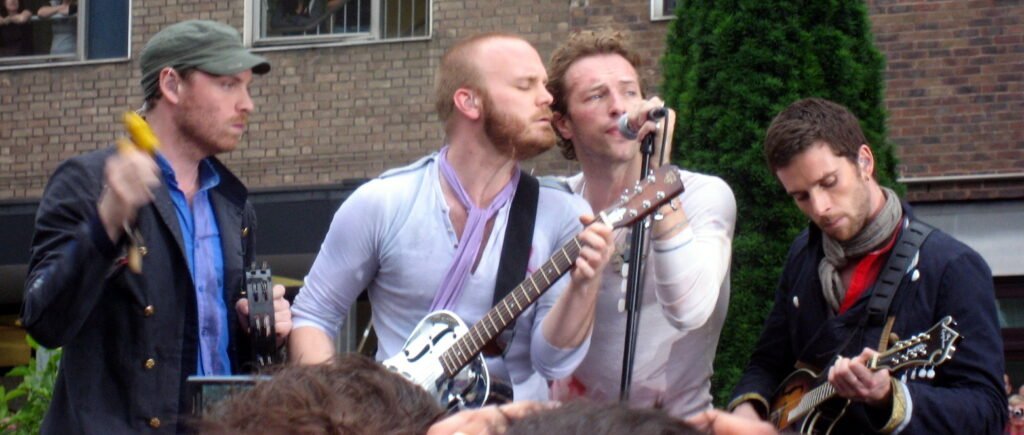
These four cross paths in the corridors of UCL and discover they share the same obsession with music and catchy melodies. They spend entire evenings doing jam sessions on the stairs of Ramsay Hall, the student dormitory, playing Beatles covers and songs scribbled on loose sheets of paper.
The band’s first name is Pectoralz, later Starfish. They perform in tiny pubs in front of twenty people, half of whom are there out of sympathy. Phil Harvey, a longtime friend of Chris, leaves his studies at Oxford to become their improvised manager. He sells copies of their music from the trunk of a car and books gigs in venues nobody has ever heard of. Phil almost becomes a fifth member, the one keeping everything running when it feels like nothing is moving.
The Early Struggles: Empty Pubs, Self-Produced EPs, and the Moment Everything Almost Ended
The early years of Coldplay’s story are filled with small daily obstacles that would have discouraged almost anyone. In 1998 they record their first EP, Safety, with their own money and sell it by hand during concerts.
One of the most symbolic moments happens at Dingwalls in Camden: they perform in front of a handful of people and sell only fifty copies of the record. And yet it is exactly there that they realize the chemistry between them truly works.
The first major crisis arrives during the recording of the Blue Room EP in 1999. Chris, driven by extreme perfectionism, gets into a fierce argument with Will over the way the drums should be played. The discussion escalates and Chris even tells him to leave the band.
For three days, the band is essentially broken up.
Then Chris realizes his mistake, writes a song to process his guilt, and calls Will to apologize. From that moment they establish three strict rules that become their sacred agreement: every decision must be unanimous, all earnings are divided into four equal parts, and no hard drugs.
Rules born from a fight between roommates, yet twenty-five years later they still hold together one of the longest-lasting bands in rock music. It’s almost funny to think that a band playing stadiums still follows rules that sound like something made by university students, but that detail made all the difference.
The turning point arrives after a showcase in a club in Manchester. They receive a call from Debs Wild at Parlophone, who wants them to produce an album with the label. They sign the contract while Chris is still preparing for his final university exams.
The final band name also arrives almost by chance. A friend, Tim Crompton, while they are waiting for a van, pulls out a children’s poetry book titled Child’s Reflections, Cold Play. Everyone loves the name immediately and they adopt it on the spot.
Coldplay are officially born.
The Breakthrough with Parachutes: From a Tiny Budget to the Song That Changed Everything
With a record deal in hand, the story of Coldplay begins to accelerate. Yet recording Parachutes is far from easy. They work with producer Ken Nelson in small studios between Liverpool and London.
The budget is tiny. The tension is high.
But it is in that atmosphere that one of their most important moments happens. During a session in Wales, Jonny plays a simple and clean chord progression. Chris looks up at the starry sky and writes the lyrics in about twenty minutes. Guy suggests a key line and the song takes shape. That is how Yellow is born.

The music video, shot in a single take on a beach in Dorset, spreads quickly in the pre-social media era thanks to word of mouth among university radio stations.
The album is released on July 10, 2000 and immediately climbs the charts: number one in the UK and a Grammy Award for Best Alternative Album.
They go from students to constant names on the radio. Tours become endless and expectations grow enormous. At this point, Coldplay face their first real pressure: how not to become a band known for only one hit.
2002: A Rush of Blood to the Head and the Birth of The Scientist
Instead of repeating the same formula, in 2002 the band travels to Norway to record A Rush of Blood to the Head, released on August 26, 2002. They want to prove they were not just a temporary success. During a soundcheck, Clocks is born, but the song that changes everything is The Scientist.
Chris sits at an old out-of-tune piano in Parr Street Studios in Liverpool. Frustrated because nothing new is coming out, he finds the instrument, plays a chord progression inspired by George Harrison, and within minutes the melody and lyrics come together.
The song, about regret and love, is released as a single in November 2002. It quickly becomes a live anthem: the audience sings every word, lights shining everywhere, and the band realizes they can combine intimacy and grandeur without losing their soul.
2005: X&Y and Fix You, the Song Written to Heal
The third album, X&Y, is released on June 6, 2005 and becomes the best-selling record in the world that year.
Here comes Fix You, released as a single on September 5, 2005. Chris writes it to comfort his wife Gwyneth Paltrow after the death of her father Bruce in 2002.
Fix You becomes one of Coldplay’s most iconic songs. In concert it turns into one of the most emotional moments, when the entire crowd lights up with phone flashes, and lighters for the nostalgic ones.

But success comes with a price. After the third album, critics begin labeling them “too clean” and “too perfect.” The band feels exhausted. Instead of playing it safe, they decide to take a risk.
2008: Brian Eno, Viva la Vida, and the Global Leap
They call Brian Eno, the legendary producer who worked with David Bowie and U2.
Eno arrives and shakes everything up:
“Try everything, even the things you don’t know how to do.”
The feedback is brutal, the sessions chaotic, but new sounds begin to emerge: African rhythms, cathedral organs, and distortions they had never used before.
Viva la Vida ends up topping more than thirty charts worldwide.
It proves that Coldplay’s story doesn’t stop with their first success. The album marks the transition from an intimate band to a global phenomenon capable of blending influences without losing its identity.
Personal Crises, Ghost Stories, and the Necessary Reset
In 2014 the darkest period arrives. Chris Martin’s separation from Gwyneth Paltrow leaves deep marks.
The next album, Ghost Stories, becomes a sonic diary of goodbyes and regrets. The band supports him by staying in the studio for weeks.
The sessions are tense and sometimes silent. Will, Jonny, and Guy become the quiet support Chris never openly asks for.
The tour that follows is deliberately smaller: theaters instead of stadiums. It may look like a step backward, but it becomes the moment when they realize the band is stronger than personal crises.
A Cultural Impact Beyond the Charts
From that moment on, Coldplay’s story becomes a constant reinvention. Mylo Xyloto in 2011 brings bright pop colors. A Head Full of Dreams in 2015 introduces cosmic sounds. Everyday Life in 2019 explores gospel and blues influences. Then come Music of the Spheres in 2021 and Moon Music in 2024 with electronic experiments.
Through it all, the lineup never changes. And the same rules from 1999 still apply.
They brought alternative rock into arenas around the world, influenced entire generations of bands, and proved that you can become massive without acting like rock stars.
Today, when you hear a new Coldplay song, you know that behind it there are still those four university students who had no idea where their journey would lead.
Chris once said that the real miracle is not selling millions of records—it’s still being friends after twenty-five years on a tour bus.
Sometimes all it takes is not giving up after the first closed door.
Or the tenth.
Because in the end, music rewards those who stay together.