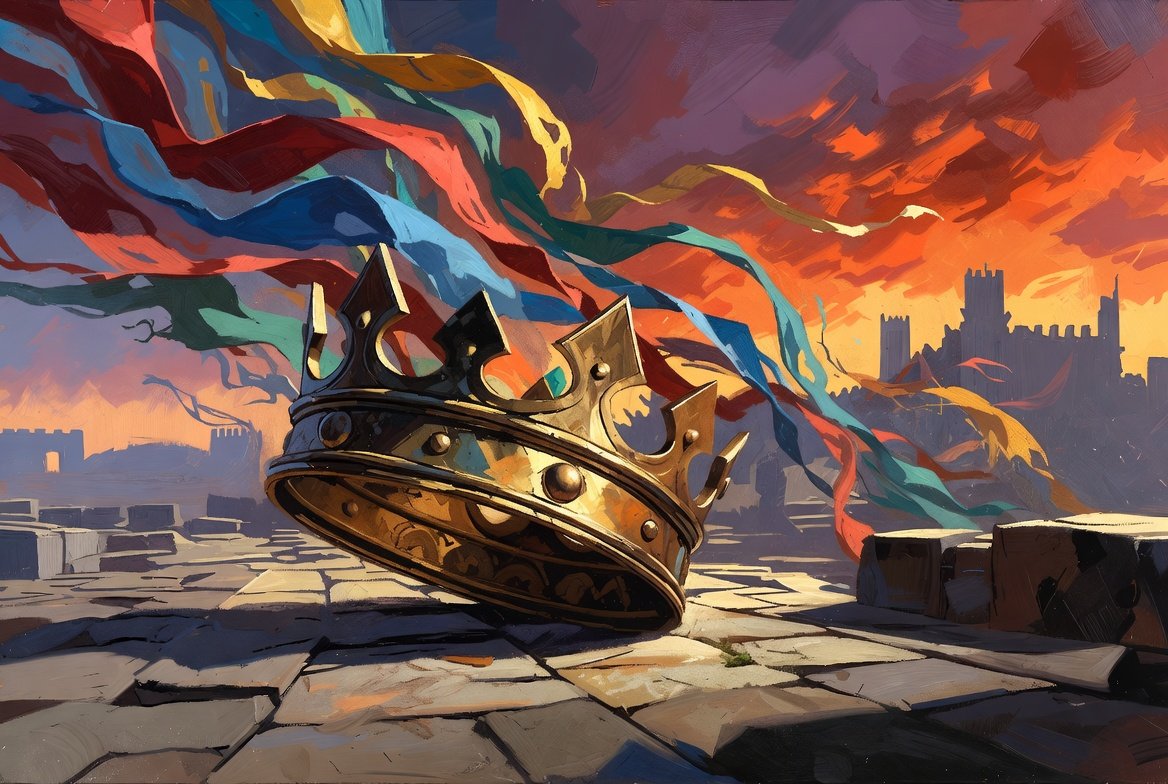
Today we talk about Viva La Vida by Coldplay, released in 2008. The song didn’t just climb charts across the world, it quickly became a reference point for anyone reflecting on the fleeting nature of success, power, and life itself.
Chris Martin and his bandmates had just closed the chapter of X&Y, a massive record that many critics considered too linear, and decided to push into new territory. The result was the album Viva La Vida or Death and All His Friends, produced with the help of Brian Eno, and a title track that still sparks discussion years later.
The title itself deserves a quick note. Viva La Vida means in Spanish “long live life” or, more literally, “live the life.” Chris Martin chose it after visiting the Casa Azul in Mexico City.
The Mexican artist Frida Kahlo, who lived with illness for most of her life, painted her final work with those words written on a watermelon. Martin was struck by the strength of that phrase, expressed by someone who endured immense pain yet chose to celebrate existence with boldness. That expression became the guiding thread of the entire project.
The creation of the song and Brian Eno’s role
After the global success of X&Y, Coldplay realized they needed to evolve. They didn’t want to repeat the formula of melancholic piano and straightforward ballads. So they shut themselves in a custom-built studio in London and brought in Brian Eno, the producer who had already reshaped the sound of U2 and David Bowie.
Eno introduced an experimental approach. He encouraged the band to record in churches, to use organs, strings, and unusual percussion, and to embrace silence as much as sound. Viva La Vida was born in this atmosphere of creative freedom.
The sessions lasted months, moving between London, New York, and Barcelona. The final track lasts just under four minutes, but behind it are layers of arrangements that make each listen richer. The result is a song that blends rock, classical influences, and a sense of epic scale without ever becoming excessive.
The historical context behind the lyrics
Many listeners quickly realize that Viva La Vida tells the story of a king who loses everything. But fewer know how deeply it is rooted in real history. The lyrics clearly allude to the French Revolution and the fate of Louis XVI.
The line “Now the old king is dead! Long live the king!” echoes the traditional proclamation of succession, but here it becomes ironic and bitter. The “new king” is the same one who has just fallen.
The album cover itself features a detail from Liberty Leading the People by Eugène Delacroix, an iconic image of revolution. Chris Martin explained in interviews that telling the story from the perspective of the dethroned ruler allowed him to explore power without judgment, showing how fragile any throne can be.
Coldplay’s path toward artistic maturity
In 2006, when they began working on this project, Coldplay were already one of the biggest bands in the world. They had sold millions of records and filled stadiums, but felt the pressure to prove they could go further.
Martin, in particular, was reflecting deeply on fame. The band traveled, experimented creatively, and searched for inspiration in new environments. This background makes Viva La Vida not just a song, but the culmination of a transformation.
The group moved from the clean, radio-friendly sound of their early work to a richer arrangement filled with choirs, strings, and rhythms that resemble a revolutionary march. The success was immediate: number one in over thirty countries, a Grammy for Song of the Year in 2009, and millions of copies sold.
The opening lines and the memory of absolute power
The song begins with a powerful image:
“I used to rule the world
Seas would rise when I gave the word”
In these lines, the king recalls a past of total control. The rising seas are not just poetic exaggeration, they evoke the divine authority that absolute monarchs claimed. Now, that same ruler sleeps alone and sweeps the streets he once owned.
The contrast is sharp, highlighting how quickly power can disappear. The repeated use of “used to” emphasizes that everything belongs to the past. The listener immediately feels the melancholy of someone who had everything and lost it without warning.
The chorus and the blend of history and religion
The chorus expands the perspective, mixing historical and biblical imagery:
“I hear Jerusalem bells a-ringing
Roman cavalry choirs are singing”
Here, sacred and imperial symbols merge. Jerusalem and ancient Rome represent power structures that relied on religion and myth to legitimize authority.
The references to mirrors, swords, and shields evoke protection and self-reflection, while the mention of “missionaries in a foreign field” suggests that even faith and expansion cannot save the fallen king.
The chorus becomes an anthem of lost grandeur, where history and spirituality intertwine to remind us that no one escapes judgment.
The bridge and the collapse of illusions
The bridge delivers the core realization:
“One minute I held the key
Next the walls were closed on me”
In just a few words, Martin captures the mechanism of downfall. One moment you control everything, the next you are trapped by the very system you ruled.
The “pillars of salt and pillars of sand” echo biblical imagery of unstable foundations. The king realizes his empire was never truly solid.
This is the turning point where the song shifts from political narrative to personal reflection. Anyone, from a monarch to an artist, can face the same illusion of permanence.
Cultural impact and legacy
Since its release, Viva La Vida has been used in sports events, commercials, and major ceremonies. Its marching rhythm and memorable melody make it universally adaptable, while the lyrics maintain depth.
It influenced listeners across generations, many of whom connect with its message without knowing the historical references. In countries like Italy, it became associated with football broadcasts and popular media, proving that an alternative rock song can enter mainstream culture without losing substance.
The connection to the album and the theme of death
Viva La Vida is part of a larger narrative within Viva La Vida or Death and All His Friends. The closing track Death and All His Friends continues and completes that story, introducing a sense of redemption.
Together, they form a duality: the celebration of life despite everything, and the acceptance of death as an inevitable companion. Martin explained that the album explores how life and death are intertwined, especially when power is involved.
Why the song still resonates today
Even in 2026, Viva La Vida feels fresh. In an era of social media success and rapid rises to fame, its message remains clear: every throne can fall in an instant.
You don’t have to be a king to relate to it. A job, a relationship, a moment of recognition, all can follow the same arc of rise and collapse.
Coldplay created a song that works on multiple levels. It moves you on the surface and makes you reflect underneath. That’s why, every time the melody begins, many people pause and think about their own “Viva La Vida.”